
How Timber Framing Shaped Rural English Homes

Why Oak, and Why It Endured
Walk through almost any rural English village and you will meet them: houses that seem to lean into the landscape, their walls a little out of true, their rooflines softened by centuries. Behind the plaster and brick, most of these homes have a skeleton of oak. Timber framing was not a style chosen for fashion, but a practical response to what the countryside provided. Oak grew widely, split and worked well when green, and hardened to remarkable strength as it dried. A carpenter could raise a frame from trees felled nearby, using little more than an axe, a saw, a chisel and a brace. The green timber shrank as it seasoned, tightening the joints rather than loosening them, so a well-made frame gripped harder with age. That is why so many have survived.
Cruck Frames and Box Frames: Two Ways to Build
Broadly, rural English timber framing falls into two families. The cruck frame uses pairs of long, naturally curved timbers—crucks—that spring from near ground level and meet at the ridge. They were often assembled on the ground and raised as a single unit, like an inverted V. Cruck buildings cluster in the west and north, from Devon and Herefordshire up into Yorkshire and Cumbria, and they suit small cottages, farmhouses and barns. The box frame, by contrast, is a cage of posts, tie beams, wall plates and principal rafters, braced with diagonal timbers. It dominates the south and east, where straight, well-grown oaks were more plentiful. Both systems could be clad in wattle and daub, weatherboarding or later brick, but the frame did the structural work.
The Joints That Did the Work
The genius of timber framing lies in its joinery. A mortise and tenon, cut by hand and secured with a tapered oak peg, can hold two timbers together for centuries. Dovetail joints tie floor joists into beams and resist being pulled apart. Scarf joints splice shorter timbers into longer lengths, often with a complex interlock that looks simple from a distance. Lap joints and bridle joints appear where braces meet posts. Carpenters cut these joints in a framing yard, numbered the timbers with Roman numerals or chisel marks, then transported and reassembled them on site. No glue, no structural nails, no metal plates—just wood, geometry and skill. The frame could flex in gales and settle without cracking, which is why it coped so well with the clay soils and exposed sites of rural England.
Reading the Frame: Clues and Character
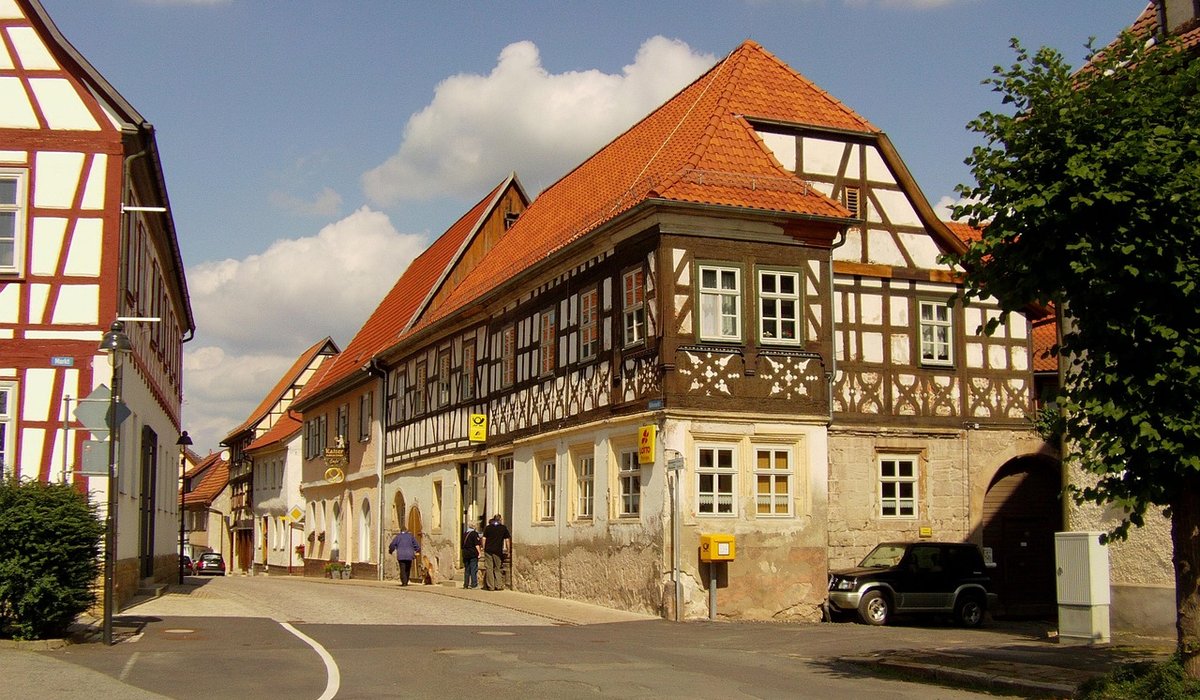
Once you know what to look for, a timber-framed house becomes a history book. Close studding—uprights set closely together—suggests display and status, common in the late fifteenth and sixteenth centuries. Square framing, with wider panels, is later and thriftier with timber. Wattle and daub panels, made from woven hazel coated in clay and straw, were gradually replaced by brick nogging, especially after the seventeenth century. Look for jettied upper floors, where each storey oversails the one below, gaining space and sheltering the base. Inside, chamfered beams, stopped chamfers and moulded ceiling joists show a carpenter’s pride. Apotropaic marks—scratched circles or burn marks—sometimes survive near openings, left to ward off harm. None of this is decoration alone; each detail tells you how the building was used, heated and adapted.
Adapting Over Centuries
Timber frames were never frozen in time. The open hall, once the heart of a medieval farmhouse, was often floored over and given a chimney in the sixteenth or seventeenth century, creating upstairs rooms and a warmer hearth. Lean-tos, rear wings and outshuts were added as families and farm work demanded. Weatherboarding protected exposed frames in the south-east, while render and later brick skins covered others. This adaptability is the frame’s great virtue: a building can be reordered internally without losing its structure. It also means that what looks like a plain cottage may contain a medieval hall, a Tudor chimney and a Georgian façade, all stitched together. Understanding that layering is essential before any repair or alteration.
Repair and Care: Practical Notes
Owning a timber-framed home is a privilege, but it asks for a particular approach. The first rule is to keep the frame dry and breathable. Cement render, plastic paints and modern sealants trap moisture, which can lead to decay in the very oak you are trying to protect. Lime render, limewash and breathable insulation allow the building to manage damp as it always has. Where timber has rotted, repair—not replacement—is usually best: splice in new oak of similar quality and grain, using traditional joints and pegs. Watch for furniture beetle, deathwatch beetle and damp, especially where timbers meet masonry or sit close to the ground. If you are planning work, commission a structural survey from someone who understands historic frames, and speak to your local conservation officer early. Small, informed interventions will keep these remarkable buildings standing for another few centuries.
- Keep it dry: repair gutters, downpipes and plinth drainage before anything else.
- Use lime: choose lime render, limewash and breathable insulation rather than cement or plastic paints.
- Repair, don't replace: splice in new oak of similar grain and cut traditional joints.
- Watch for pests and damp: check beetle holes, soft timber and any contact with masonry or soil.
- Get specialist advice: commission a survey from someone who knows historic frames, and speak to your local conservation officer early.

Joeby Ragpa
This template is so awesome. I didn’t expect so many features inside. E-commerce pages are very useful, you can launch your online store in few seconds. I will rate 5 stars.
ReplyAlexander Samokhin
This template is so awesome. I didn’t expect so many features inside. E-commerce pages are very useful, you can launch your online store in few seconds. I will rate 5 stars.
ReplyChris Root
This template is so awesome. I didn’t expect so many features inside. E-commerce pages are very useful, you can launch your online store in few seconds. I will rate 5 stars.
Reply